
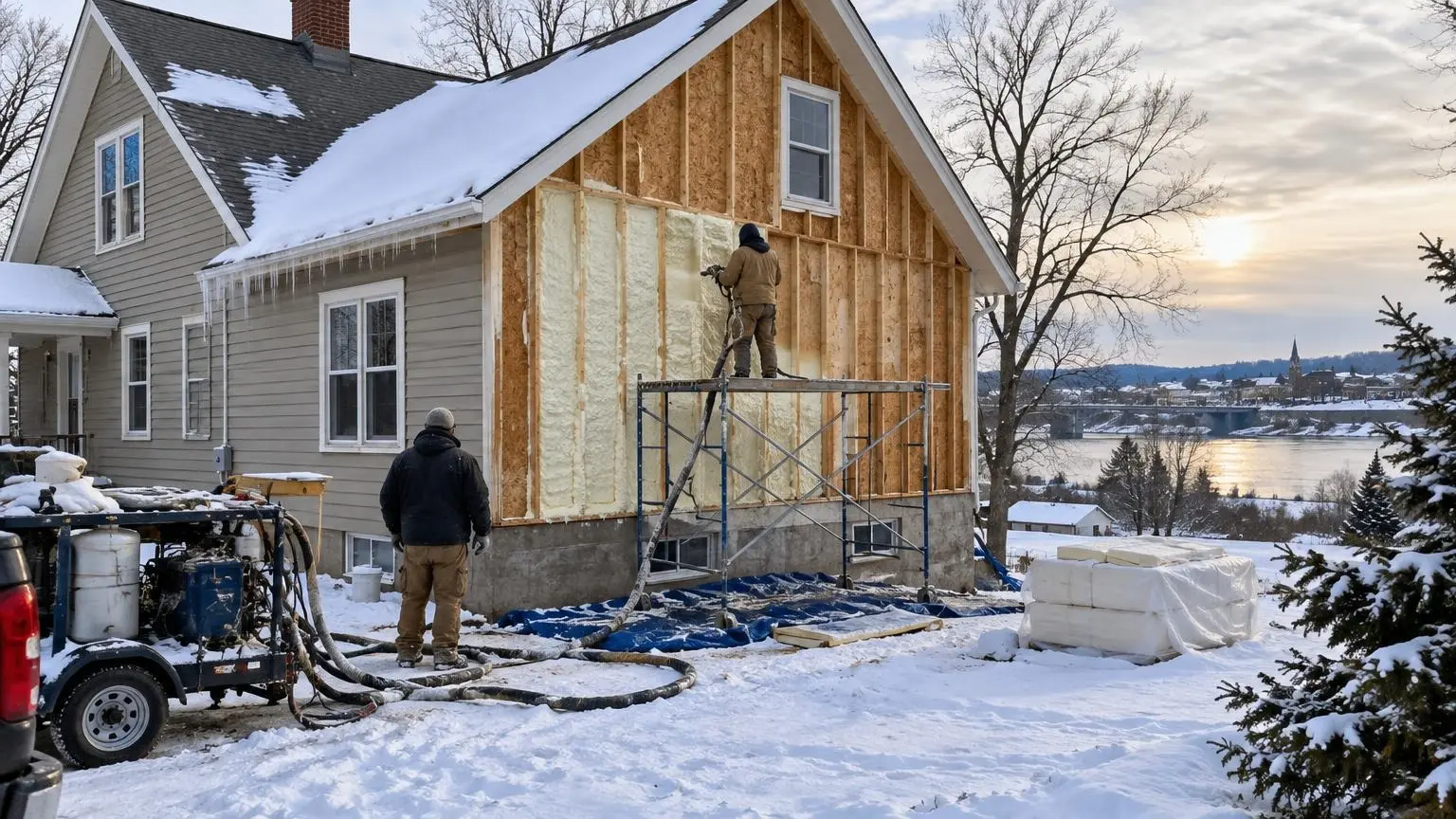
Rim joists, basement walls and crawl spaces
Rim Joist & Basement Insulation in St. Cloud, MN
Seal the framing band that rests on the foundation, and insulate walls buried in frozen ground half the year.
- Free on-site estimates
- Written quote showing the material, thickness and target R-value area by area
- Foundation walls checked for moisture before any foam goes on
The Bottom of the House Matters Too
Rim Joist & Basement Insulation in St. Cloud often does more for comfort than people expect. The rim joist is the band of lumber that sits on top of the foundation and holds the ends of the floor joists. In most basements it is covered by a loose piece of fiberglass, or nothing at all, and it leaks air around the sill plate, through gaps in the siding sheathing and around every pipe and wire that passes through. Cold air pulled in there is what makes the first floor feel drafty at ankle height.
Why closed-cell foam fits here
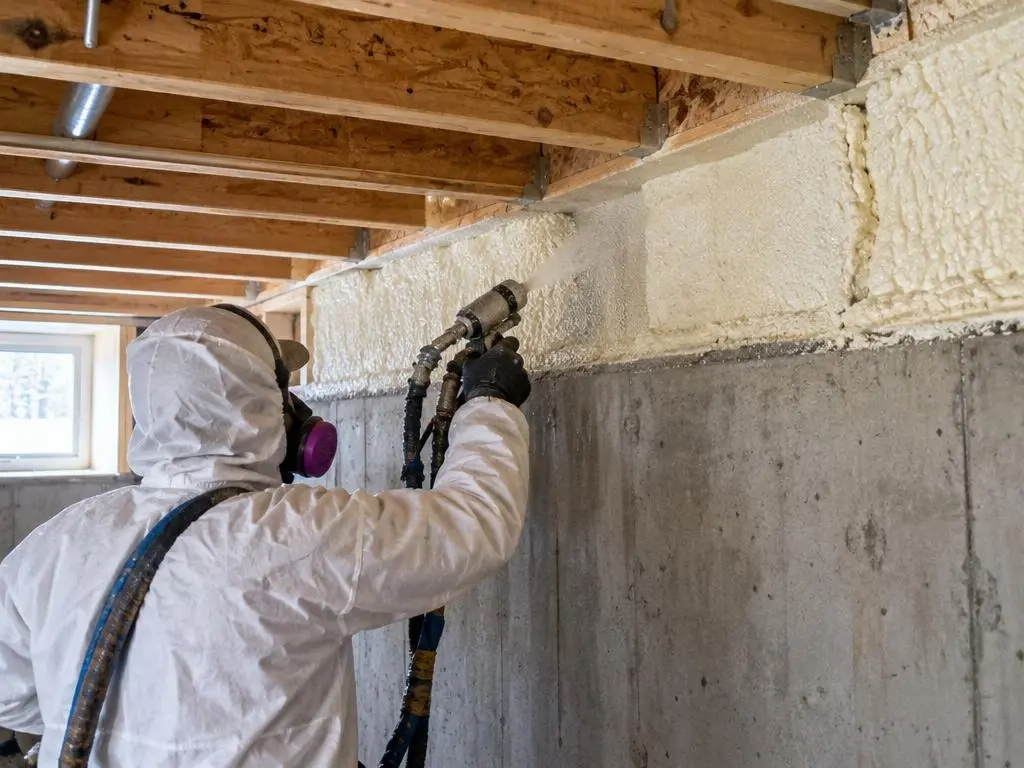
Fiberglass batts stuffed against a rim joist let damp indoor air reach the cold wood behind them. In January that air condenses, and over time the wood can stay wet and the batt can grow mold. Closed-cell foam sprayed directly against the rim and sill fills every gap, stops air movement, and at a couple of inches thick acts as its own vapor control. HomeGuide puts it around R-5 to R-7 per inch. This is not a job for open-cell foam: the Department of Energy recommends keeping it above ground level, and it lets vapor through to the cold surface.
Frozen soil against the walls
Minnesota's building rules put Stearns, Benton and Sherburne counties in the zone where footings must go at least 3-1/2 feet down for frost, and Mille Lacs County, around Milaca, in the 5-foot zone. The top few feet of a basement wall sit in that frozen ground and in open air above it for months. That upper section loses the most heat. Insulating the rim and the foundation wall from the inside keeps the floor above warmer and makes a finished lower level comfortable to use in winter.
Basement insulation before you finish
The best time to insulate basement walls is before framing and drywall go up. Closed-cell foam can go directly on poured concrete or block, sealing cracks and the joint at the sill as it goes. Then the stud wall can be built in front of it without batts and plastic sheeting, which can trap moisture against cold concrete. Once a basement is finished, getting back to the rim joist means cutting into the ceiling, so it is worth doing now even if the finishing work is a year off.
Moisture comes first
Foam is not a waterproofing product. Before quoting basement walls, we look for efflorescence, stains, damp spots, cracks that leak in spring and grading that sends water toward the house. If water is coming through, that has to be fixed first, usually with gutters, downspout extensions, grading or drainage work. You will hear exactly what we find. Insulating over a wet wall hides the problem until it shows up as rot or mold.
Crawl spaces and older foundations
Many older homes and lake cabins sit partly or wholly on crawl spaces, sometimes with stone or block walls. Closed-cell foam bonds to irregular masonry and seals the rim at the same time. When a crawl space is being sealed, we insulate the walls and rim rather than the floor above, and a ground vapor barrier goes down. HomeGuide lists a vapor barrier at $1,200 to $4,000 and closed-cell crawl space walls at $2 to $5 per square foot.
Covering the foam
In a finished basement or any space people use, foam normally needs a fire-resistant covering such as drywall. Some products are listed for exposed use in certain areas with a specific coating. We go over what your basement needs on the quote so the finishing plan is clear.
Basement insulation and the rest of the house
A tighter basement changes how the whole house breathes. Sealing the rim cuts the cold air that gets drawn in low and pushed out through the attic, so the attic often sees less frost afterward. It also means less fresh air leaks in on its own. In most houses that is a good thing, but if you have an older gas appliance that draws combustion air from the basement, it is worth having it checked. We will mention anything we see on our visit, such as a water heater or furnace that pulls air from the room, so you can have a heating contractor confirm it has what it needs before and after the work.
Walk-out and partly exposed basements
A walk-out or a basement on a sloped lot has some walls fully buried, some half exposed and some above grade with windows and doors. Each section loses heat differently. The exposed parts behave like any above-grade wall and lose the most, so we often put more foam there. We map each wall on the quote with its own thickness so you can see how the plan follows the ground outside.
Radon and sealing
Sealing a basement does not replace radon testing or mitigation. If you have a radon system, we keep foam clear of the fan, pipe and labels, and we suggest retesting after any major sealing work.
Basement and Rim Joist Work
The lower level of a house usually needs some combination of these.
Rim joist and sill sealing
Closed-cell foam on the rim boards and sill plate all the way around the basement.
Foundation wall insulation
Closed-cell on poured or block walls before framing, or on exposed walls in a utility area.
Crawl space walls and rim
When a crawl space is being closed up, we spray its walls and rim joists with foam.
Ground vapor barrier
Heavy sheeting over a dirt or gravel crawl space floor, sealed at the walls.
Penetration sealing
Gaps around dryer vents, hose bibs, gas lines and wiring sealed where they pass through the rim.
Published Basement and Rim Joist Costs
| Job | Published range | Source |
|---|---|---|
| Rim joists, spray foam | $2,000 to $2,500 | HomeGuide |
| Closed-cell foam, installed | $3.00 to $5.00 per sq ft | HomeGuide |
| Crawl space, spray foam | $2,000 to $4,000 | HomeGuide |
| Crawl space, spray foam | $1,000 to $5,900 | Fixr |
| Closed-cell crawl space walls | $2 to $5 per sq ft | HomeGuide |
| Crawl space vapor barrier | $1,200 to $4,000 | HomeGuide |
These national ranges are drawn from two HomeGuide guides (spray foam, crawl spaces) plus Fixr's spray foam guide. Perimeter length, wall height, access and any water fixes change the cost. We hold to the number on your written estimate.
How a Basement Job Runs
1. Moisture and access check
We look at walls and rim for water signs and note anything in the way, such as ducts, wiring or stored items.
2. Quote by section
Rim, walls and crawl space are priced separately with foam thickness and R-value.
3. Clear and protect
Old batts come out of the rim, the floor and nearby equipment get covered, and ventilation is set up.
4. Spray
Closed-cell goes on in layers to the agreed depth, sealing gaps at the sill as it goes.
5. Clean up and review
We remove waste, check coverage with you and explain any covering the area needs.
Why Choose Us for Rim Joist & Basement Insulation
Water before foam
We will not spray over a wall that is taking on water, and we tell you what to fix.
Closed-cell below grade
No open-cell on foundation walls, in line with DOE guidance.
Planned with your finish work
We talk through framing and covering so the basement build goes smoothly after us.
Rim Joist & Basement Insulation Questions
Is rim joist insulation worth it?
In most Minnesota basements it is one of the most cost-effective insulation jobs. The rim leaks a lot of air, it is easy to reach in an unfinished basement and closed-cell foam handles it in one visit. HomeGuide lists rim joist foam at $2,000 to $2,500.
Would fiberglass batts work on my rim joist instead?
Batts slow heat but let damp indoor air reach the cold rim, where it can condense and keep the wood wet. Closed-cell foam seals the air and controls vapor in one layer, which is why it is the usual recommendation.
How thick should foam be on basement walls?
It depends on the R-value you want and the finishing plan. Closed-cell runs about R-5 to R-7 per inch according to HomeGuide, so a couple of inches gets a meaningful R-value without taking much floor space. We write the thickness and R-value on the quote.
My basement gets damp every spring. Is insulating it still an option?
Not until the water source is dealt with. We will flag what we notice, such as grading, downspouts or cracks, and return once the wall stays dry.
Do I need to cover the foam in my basement?
If the space is finished or used regularly, foam normally needs a fire-resistant covering such as drywall. We explain what your area needs before the job.

Rim Joist & Basement Insulation Service Areas
- Spray Foam Insulation in St. Cloud, MN
- Spray Foam Insulation in Sartell, MN
- Spray Foam Insulation in Sauk Rapids, MN
- Spray Foam Insulation in Waite Park, MN
- Spray Foam Insulation in St. Joseph, MN
- Spray Foam Insulation in Cold Spring, MN
- Spray Foam Insulation in Rockville, MN
- Spray Foam Insulation in Clearwater, MN
- Spray Foam Insulation in Becker, MN
- Spray Foam Insulation in Big Lake, MN
- Spray Foam Insulation in Elk River, MN
- Spray Foam Insulation in Monticello, MN
- Spray Foam Insulation in Annandale, MN
- Spray Foam Insulation in Paynesville, MN
- Spray Foam Insulation in Albany, MN
- Spray Foam Insulation in Melrose, MN
- Spray Foam Insulation in Sauk Centre, MN
- Spray Foam Insulation in Avon, MN
- Spray Foam Insulation in Rice, MN
- Spray Foam Insulation in Foley, MN
- Spray Foam Insulation in Princeton, MN
- Spray Foam Insulation in Milaca, MN
- Spray Foam Insulation in Cambridge, MN
- Spray Foam Insulation in Alexandria, MN
- Spray Foam Insulation in Zimmerman, MN
Get a Rim Joist & Basement Insulation Estimate
Free rim joist and basement estimates around St. Cloud.