
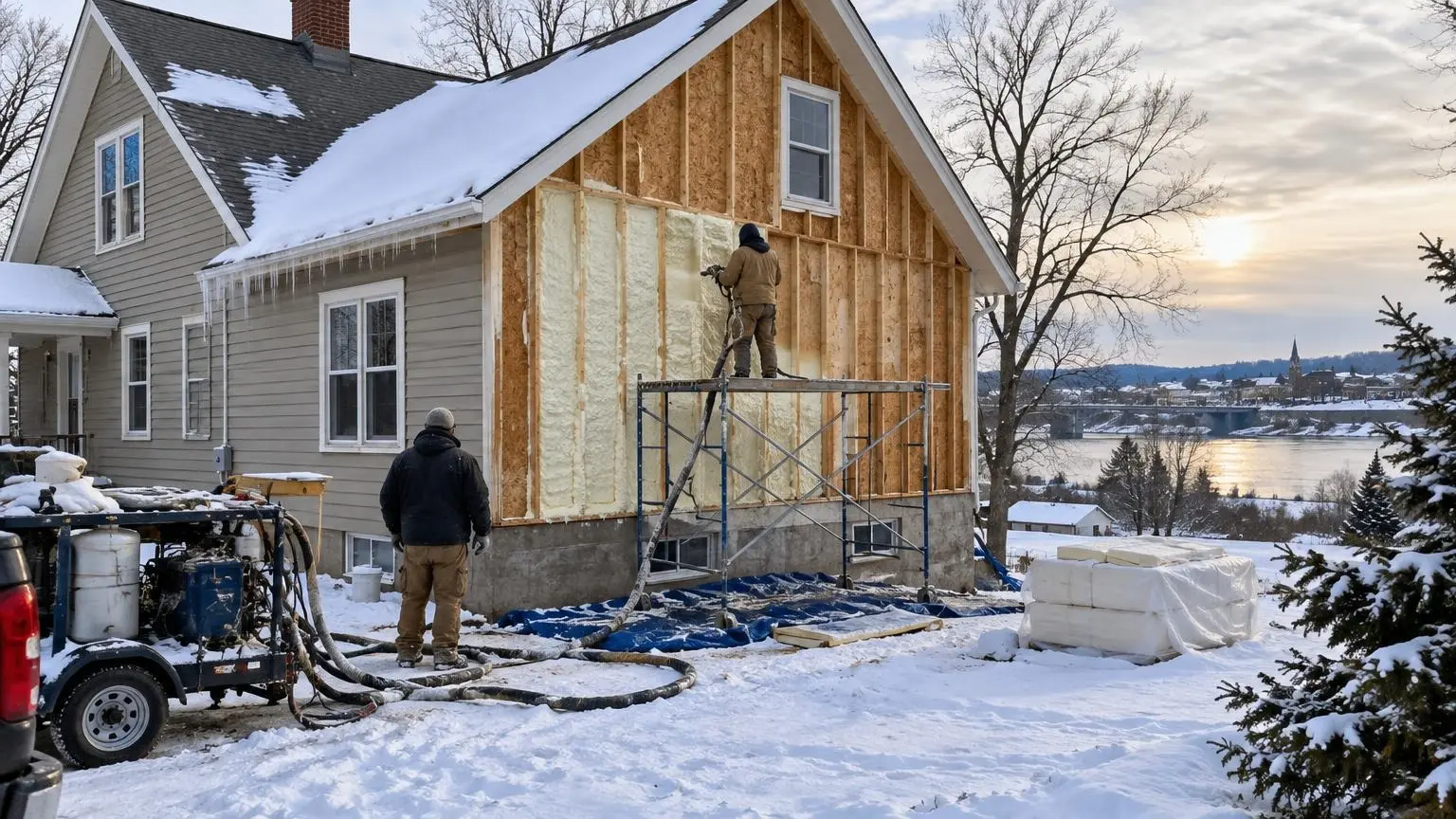
Insulation for Central Minnesota winters
Spray Foam Insulation in St. Cloud, MN
Closed-cell and open-cell foam, blown-in depth and air sealing, matched to each part of your house, cabin or shop.
- Free on-site estimates
- Written quote showing the material, thickness and target R-value area by area
- Foundation walls checked for moisture before any foam goes on
Keeping Heat Inside Through a St. Cloud Winter
Few places ask more of spray foam insulation than St. Cloud. This is a city with an all-time record low of -43 F, a January that averages 11.6 F, and close to 48 inches of snow a year at the airport. A house here burns fuel for months to hold heat that slips out through the rim joist, the attic floor and every wire hole in between. Spray Foam Insulation St. Cloud insulates homes, cabins, garages and pole buildings across Stearns, Benton and Sherburne counties. Our work is deciding where foam is worth paying for, where blown-in does the same job for less, and where old material has to come out first.
Stop the air, then add depth
Warm air rises. In a heated house on a cold night it pushes up and out through the top of the building and pulls cold air in near the bottom. That flow carries moisture with it. When damp indoor air reaches the underside of a frozen roof deck, it turns to frost, and the frost melts back onto the insulation on the first sunny afternoon. The same leaking heat warms the roof from below, melts snow and refreezes it at the eaves as an ice dam. Piling more fluff on the attic floor does not fix that, because loose insulation slows heat but lets air move straight through it. Sealing the gaps first is what changes how a house behaves in February. Spray foam is one of the strongest tools for that, since it fills the cavity and bonds to the framing as it expands.
Closed cell vs open cell for a cold climate
These are two different products. Per HomeGuide, open-cell foam delivers roughly R-3.5 to R-3.7 per inch, while closed-cell reaches about R-5 to R-7 per inch. The open-cell kind is soft, light and cheaper, and it allows water vapor to move through it. The Department of Energy says it should not go in below grade, where it can soak up water. Closed-cell is dense and rigid, blocks both vapor and liquid water, and packs more R-value into a thin space. That is why it is the usual pick for rim joists, basement walls, steel pole buildings and cantilevered floors. Open-cell earns its place on roof decks or inside walls that have depth to fill. A frequent question is whether spray foam will keep moisture out. Closed-cell resists moisture, but no foam cures a wall with water seeping through, so we inspect foundations before any spraying.
Frozen ground and heavy snow
State rules put Stearns, Benton and Sherburne counties in the zone where footings must sit at least 3-1/2 feet down for frost, and they design buildings in all three for a 50 pound per square foot ground snow load. Those two numbers explain most of what we see. The top few feet of a basement wall sit in frozen soil for much of the winter, so the rim joist and upper wall are cold, leaky and easy to fix with closed-cell foam. Roofs carry heavy snow for weeks, so any heat that escapes into the attic shows up as ice along the eaves.
When to schedule insulation work
Attic and blown-in work can happen any time of year, though a mid-summer attic gets very hot and a January attic shows us exactly where the frost and leaks are. Spray foam in basements and pole buildings can go on in winter as long as we warm the space and the surface to the product's range first. Fall is the busiest stretch, when people notice the first cold floors and the first icicles. If you are planning to finish a basement, re-roof, or turn a cabin into a year-round place, call before that work starts. Insulating while the framing is open costs less and gets a better result than coming back later.
What spray foam insulation cost looks like
Published national ranges give a starting point. Installed spray foam runs about $1.50 to $5.00 per square foot in HomeGuide's figures. Within that span, HomeGuide prices open-cell at $1.50 to $3.50 and closed-cell at $3.00 to $5.00. It lists a typical attic at $3,000 to $8,000 and rim joists at $2,000 to $2,500, and notes that many companies set a minimum of $1,000 to $2,000 or more. For an attic floor, blown-in insulation runs $900 to $3,600 in the same guide, which is why we do not push foam where it is not needed. The real number depends on area, depth, access and what has to come out first. Your written estimate is the price we work to.
The drawbacks, plainly
Spray foam costs more per square foot than blown-in or batts. It is hard to remove once it cures, so a bad plan is expensive to undo. The house has to be empty while it is sprayed and for a period after; HomeGuide suggests allowing 24 hours or longer, and we give you the product's re-entry time in writing. Foam on a roof deck can hide a slow leak, so we check the roof first. It also needs to go on at the right temperature and thickness, which is one reason the DIY kits sold at big-box stores tend to work for patching small gaps but not for whole walls or rooflines.
Questions to ask insulation contractors
Whoever you hire, ask the same things. What material goes in each area, how thick, and what R-value will it reach? What gets air sealed, and how? Will old insulation be removed, and where does it go? How long must the house stay empty after spraying? Do you check the roof and foundation for moisture before covering them? Good spray foam insulation contractors and insulation companies will answer in writing without being pushed. If a quote just says "spray foam, $X," ask for the breakdown before you sign.
Houses, rentals, cabins and shops
The 2020 census counted 29,215 housing units in St. Cloud, and Census QuickFacts puts the owner-occupied share at 48.6 percent, so a lot of our calls come from landlords as well as homeowners. Rental owners usually want durable work that stops cold-bedroom complaints. Owner-occupants are often getting ready to finish a basement or fix a cold room over the garage. Outside town we see seasonal cabins being turned into year-round places and steel pole buildings that drip with condensation every winter. Each gets its own plan, priced area by area.
Our Insulation Services
Six services, ranging from sealing a rim joist with closed-cell foam to stripping an old attic down and starting over.
Spray Foam Insulation
Closed-cell and open-cell spray foam for rim joists, rooflines, walls and cantilevers, air sealing and insulating at once.
Learn more →Attic Insulation
Air sealing the attic floor, then building depth toward R60 to cut heat loss, frost and ice dams.
Learn more →Rim Joist & Basement Insulation
Closed-cell foam on the rim joist and foundation walls, the cold, drafty bottom of most Minnesota houses.
Learn more →Pole Building & Garage Insulation
Closed-cell foam on steel pole barns, shops and garages to stop condensation and hold heat.
Learn more →Blown-In Insulation
Cellulose or fiberglass, blown over an attic floor after sealing or dense-packed into closed walls.
Learn more →Insulation Removal & Replacement
Vacuuming out wet, dirty or damaged insulation, sealing the attic, then installing new material.
Learn more →
Common Questions
Will spray foam keep moisture out?
Closed-cell foam resists both water vapor and liquid water, which is why it goes on rim joists and basement walls. Open-cell foam lets vapor pass and should stay above ground, according to the Department of Energy. Neither one fixes a wall that is actively leaking, so we look for water first and let you know if drainage has to be addressed before any insulation goes in.
What should I budget for spray foam in my attic?
HomeGuide lists a typical spray-foamed attic at $3,000 to $8,000, and Fixr gives $2,500 to $12,000 for attics in existing homes. If the attic floor is open and easy to reach, air sealing plus blown-in insulation often does the job for less; HomeGuide puts blown-in attics at $900 to $3,600. We quote both when both would work.
What are the drawbacks of spray foam insulation?
It costs more than blown-in or batts, it is difficult to remove, and the house has to be empty during spraying and for a set time afterward. It can also hide roof leaks if it goes on a deck that already has problems. Those are reasons to use it where it pays off, like rim joists and tight spaces, rather than everywhere.
Is a DIY closed-cell spray foam kit worth it?
Kits can work for small, easy jobs such as a short stretch of rim joist or a few gaps around pipes. They are harder to apply evenly, sensitive to temperature, and expensive per board foot over large areas. For whole basements, rooflines or pole buildings, professional equipment gives a more even, predictable result.
How much attic insulation does a St. Cloud house need?
The Department of Energy lists R60 for an uninsulated attic in its two coldest zones, 6 and 7, and R49 to add when 3 to 4 inches are already there. We measure what you have and write down the depth needed to reach the target.
Does spray foam help with ice dams?
Ice dams form when attic heat melts snow on the roof. Sealing the air leaks from the living space into the attic is the biggest step toward stopping that, and foam is very effective at sealing those gaps. Enough insulation depth and clear soffit vents finish the job.
How long do we have to stay out of the house?
Plan on at least 24 hours for most professional spray foam, which is the figure HomeGuide gives, but it depends on the product, thickness and conditions. Before we start, we hand you the re-entry time the manufacturer specifies, in writing. Blown-in insulation does not need you to leave.
Why Homeowners Call Spray Foam Insulation St. Cloud
Air sealing before depth
Before insulation covers anything, we seal top plates, wire and pipe holes, the hatch, chimney gaps and the rim joist.
The material fits the spot
Closed-cell where moisture and cold concrete are involved, open-cell or blown-in where they are not, with the reason written on the quote.
We look before we cover
Roof leaks, ice dam staining, nests, damp walls and vermiculite are checked and pointed out before anything is insulated over.
R-values in writing
Each area on the quote names its material, thickness and target R-value, which makes it easy to compare bids line by line.
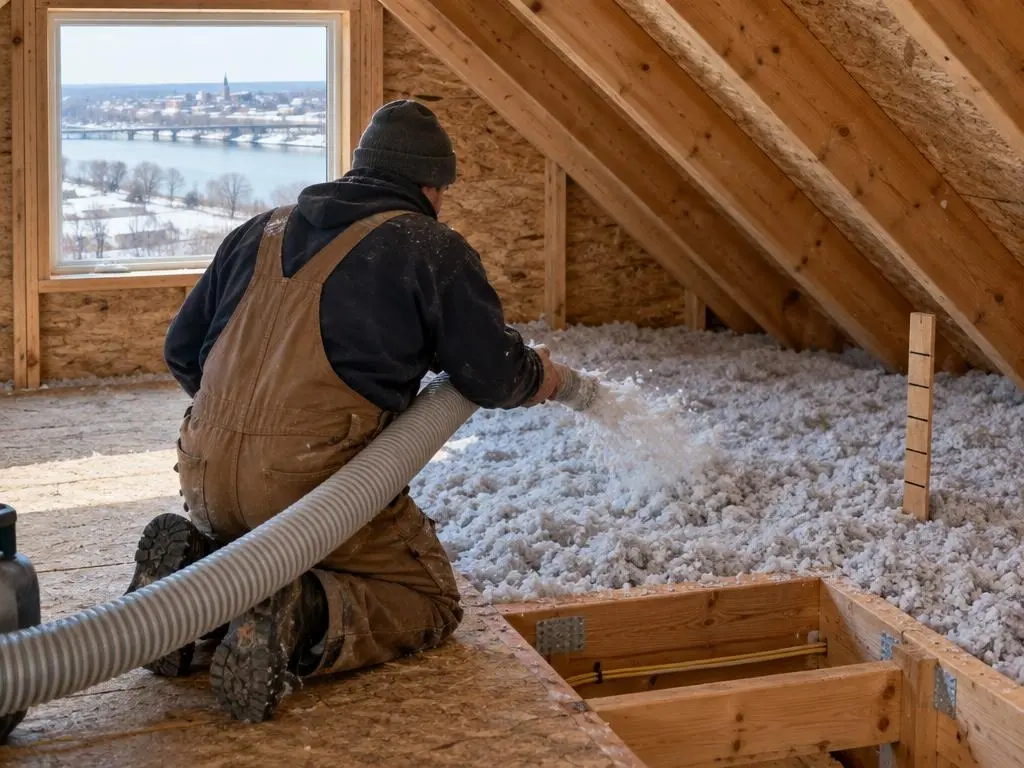
Towns We Cover Around St. Cloud
St. Cloud is the center of our work, on both sides of the Mississippi and across all three of its counties. Close in, we cover Sartell, Sauk Rapids, Waite Park and St. Joseph. To the south and west we travel to Cold Spring, Rockville, Paynesville, Albany, Avon, Melrose, Sauk Centre and Alexandria. Down the river and toward the metro we work in Clearwater, Becker, Big Lake, Elk River, Monticello, Annandale and Zimmerman, and north and east in Rice, Foley, Milaca, Princeton and Cambridge. The ground and the snow are not the same everywhere: Mille Lacs County, around Milaca, sits in the state's deeper 5-foot frost zone and its heavier 60 pound snow load group. Each town page covers what is specific to that place.
- Spray Foam Insulation in St. Cloud, MN
- Spray Foam Insulation in Sartell, MN
- Spray Foam Insulation in Sauk Rapids, MN
- Spray Foam Insulation in Waite Park, MN
- Spray Foam Insulation in St. Joseph, MN
- Spray Foam Insulation in Cold Spring, MN
- Spray Foam Insulation in Rockville, MN
- Spray Foam Insulation in Clearwater, MN
- Spray Foam Insulation in Becker, MN
- Spray Foam Insulation in Big Lake, MN
- Spray Foam Insulation in Elk River, MN
- Spray Foam Insulation in Monticello, MN
- Spray Foam Insulation in Annandale, MN
- Spray Foam Insulation in Paynesville, MN
- Spray Foam Insulation in Albany, MN
- Spray Foam Insulation in Melrose, MN
- Spray Foam Insulation in Sauk Centre, MN
- Spray Foam Insulation in Avon, MN
- Spray Foam Insulation in Rice, MN
- Spray Foam Insulation in Foley, MN
- Spray Foam Insulation in Princeton, MN
- Spray Foam Insulation in Milaca, MN
- Spray Foam Insulation in Cambridge, MN
- Spray Foam Insulation in Alexandria, MN
- Spray Foam Insulation in Zimmerman, MN
Book a Free Insulation Visit
We visit, take measurements, and price every part of the house on a written quote.