
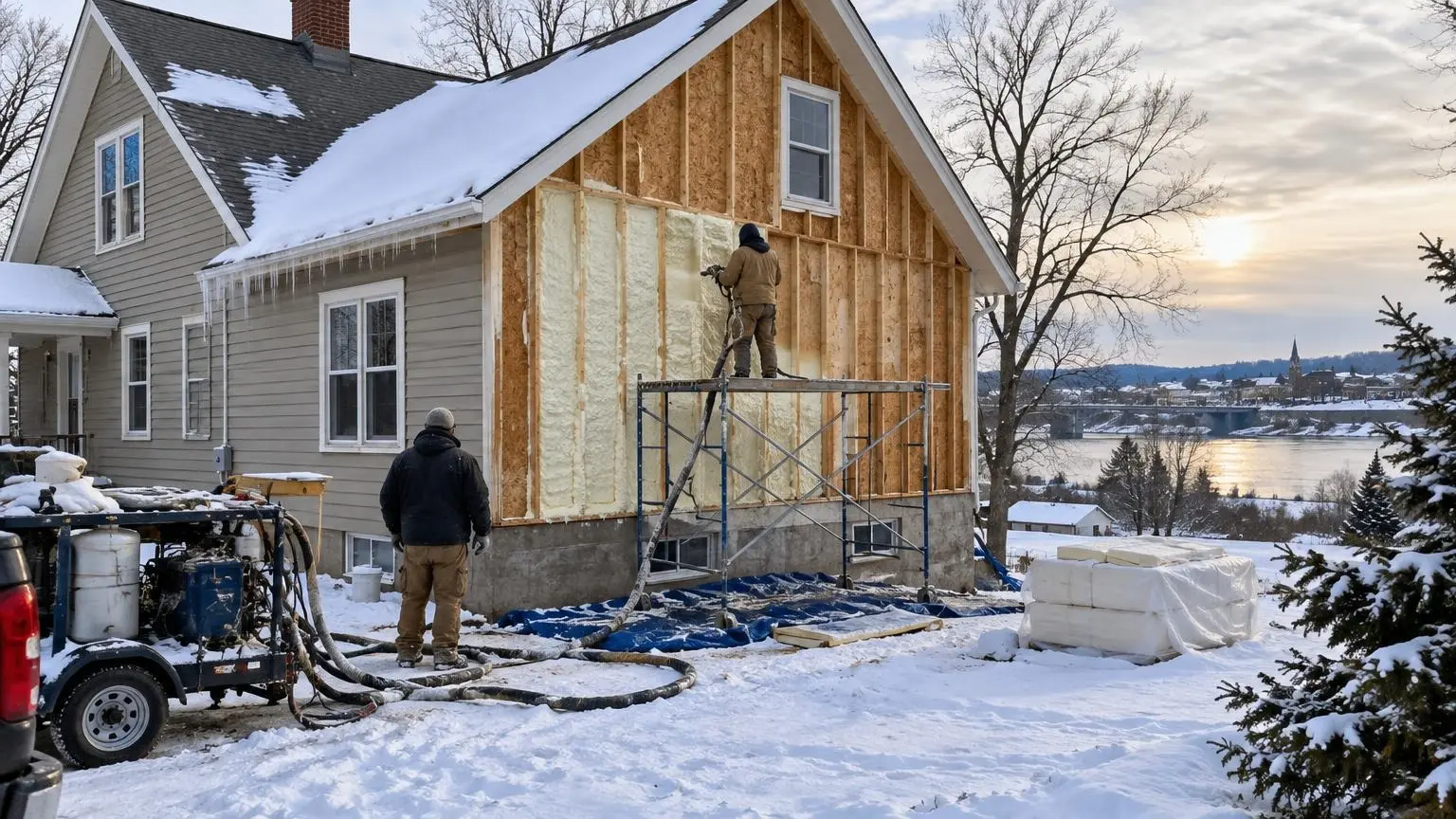
Big Lake, Sherburne County, on Big Lake and Mitchell Lake
Spray Foam Insulation in Big Lake, MN
A former ice-harvesting town that became a commuter exurb, with plenty of newer homes and lakeside lots.
- Free on-site estimates
- Written quote showing the material, thickness and target R-value area by area
- Foundation walls checked for moisture before any foam goes on
From Ice Harvest to Commuter Homes
In Big Lake, commuter homes account for most spray foam insulation requests. The town began as a place to harvest ice from its lakes, with a rail station built in 1871, and stayed small for a long time: 177 people lived here in 1900. Then came the growth years. The population went from 6,063 in 2000 to 10,060 in 2010 and 11,686 in 2020, and growth on that scale brings a lot of new houses.
What we see in newer Big Lake houses
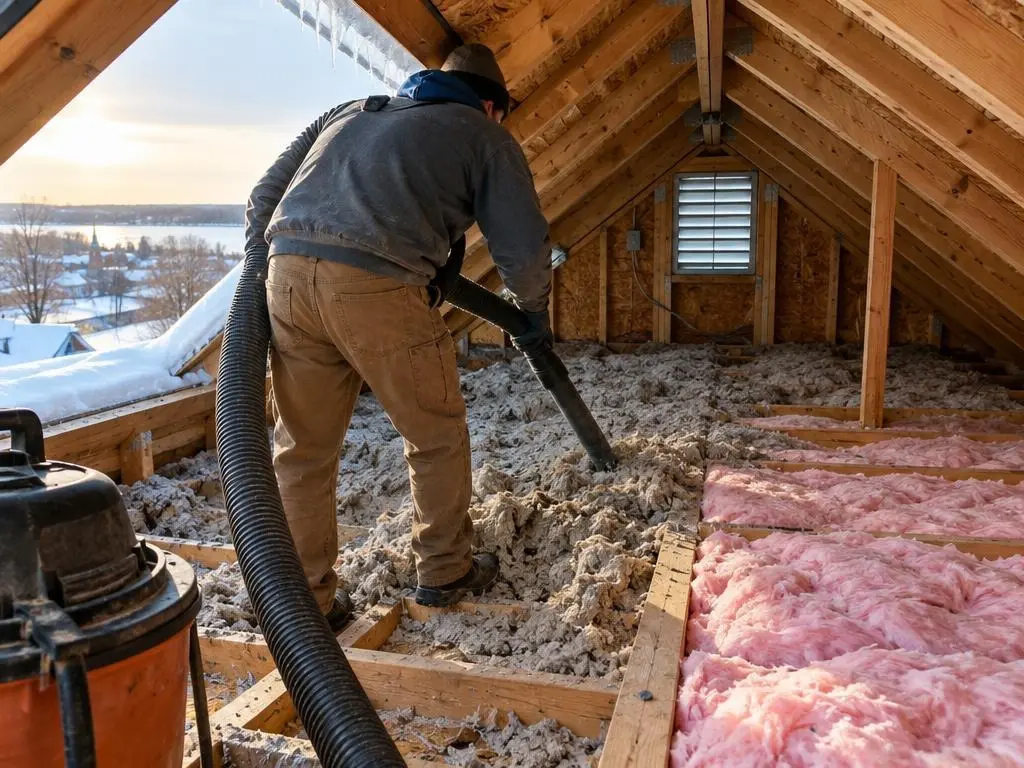
Tract homes from the 2000s typically have blown fiberglass in the attic at a decent depth, but the air barrier under it was rarely perfect. Bath fan housings, recessed lights, wire holes and the attic hatch let warm air reach the cold side. In a climate like ours, that warm air carries moisture that frosts on the roof sheathing. Sealing first and then adding depth fixes both the energy loss and the frost.
Living on the water
Big Lake is connected by a small channel to Mitchell Lake, and about 0.8 of the city's 2.92 square miles is water. Lakeside homes often have walkout basements facing the lake, where the exposed wall and rim catch the wind off the ice. Closed-cell foam on that rim joist and on the above-grade parts of the walkout makes the lower level far more comfortable.
Young families and finished basements
The city's median age in 2020 was 32.7. Many households are growing and looking at finishing the lower level. If that is your plan, have the rim joist and foundation walls foamed before framing. Open-cell foam is not suited to basements, according to the DOE, because it can absorb water below grade. Closed-cell is the right choice.
Snow and ice dams
Sherburne County homes are designed for a 50 psf ground snow load under state rule. When that snow sits on a roof over a leaky attic, ice dams follow. Air sealing is the long-term answer.
The commuter rail that once served Big Lake was replaced by bus service in January 2026, but the town's role as a bedroom community for the Twin Cities continues. Get a free estimate or call (320) 433-6603.
Big Lake at a Glance
- Ice-harvest origins. Big Lake, originally called Humboldt until 1867, was established to harvest ice from its lakes, and a railway station was built in 1871.
- Growth. The population grew from 6,063 in 2000 to 10,060 in 2010 and 11,686 in 2020, a 65.9% rise in the first decade.
- Water. Big Lake is linked to Mitchell Lake by a small channel, and about 0.80 of the city's 2.92 square miles is water.
- Snow load. Sherburne County buildings are designed for a 50 pound per square foot ground snow load under Minnesota rule 1303.1700.
Big Lake Questions
Why does my newer Big Lake house get frost in the attic?
Warm, moist air is leaking into the attic through gaps at lights, fans and wiring. It freezes on the cold roof deck. Air sealing the attic floor is the fix, followed by added depth.
My walkout basement faces the lake and feels drafty. What helps?
Closed-cell foam on the rim joist and exposed upper walls usually makes the biggest difference, because those areas catch the wind off the lake.
Is open-cell foam OK for my basement?
The DOE advises against open-cell foam below ground because it can absorb water. We use closed-cell in basements.
How long does spray foam take in a typical Big Lake home?
A rim joist is often done in part of a day. Attic sealing and top-up is usually a day. We will give you a schedule with the written quote.
Free Estimates in Big Lake, MN
Lakeshore or new subdivision, we measure Big Lake homes for free.
Spray Foam Insulation Near Big Lake
- Spray Foam Insulation in St. Cloud, MN
- Spray Foam Insulation in Sartell, MN
- Spray Foam Insulation in Sauk Rapids, MN
- Spray Foam Insulation in Waite Park, MN
- Spray Foam Insulation in St. Joseph, MN
- Spray Foam Insulation in Cold Spring, MN
- Spray Foam Insulation in Rockville, MN
- Spray Foam Insulation in Clearwater, MN
- Spray Foam Insulation in Becker, MN
- Spray Foam Insulation in Elk River, MN
- Spray Foam Insulation in Monticello, MN
- Spray Foam Insulation in Annandale, MN
- Spray Foam Insulation in Paynesville, MN
- Spray Foam Insulation in Albany, MN
- Spray Foam Insulation in Melrose, MN
- Spray Foam Insulation in Sauk Centre, MN
- Spray Foam Insulation in Avon, MN
- Spray Foam Insulation in Rice, MN
- Spray Foam Insulation in Foley, MN
- Spray Foam Insulation in Princeton, MN
- Spray Foam Insulation in Milaca, MN
- Spray Foam Insulation in Cambridge, MN
- Spray Foam Insulation in Alexandria, MN
- Spray Foam Insulation in Zimmerman, MN