
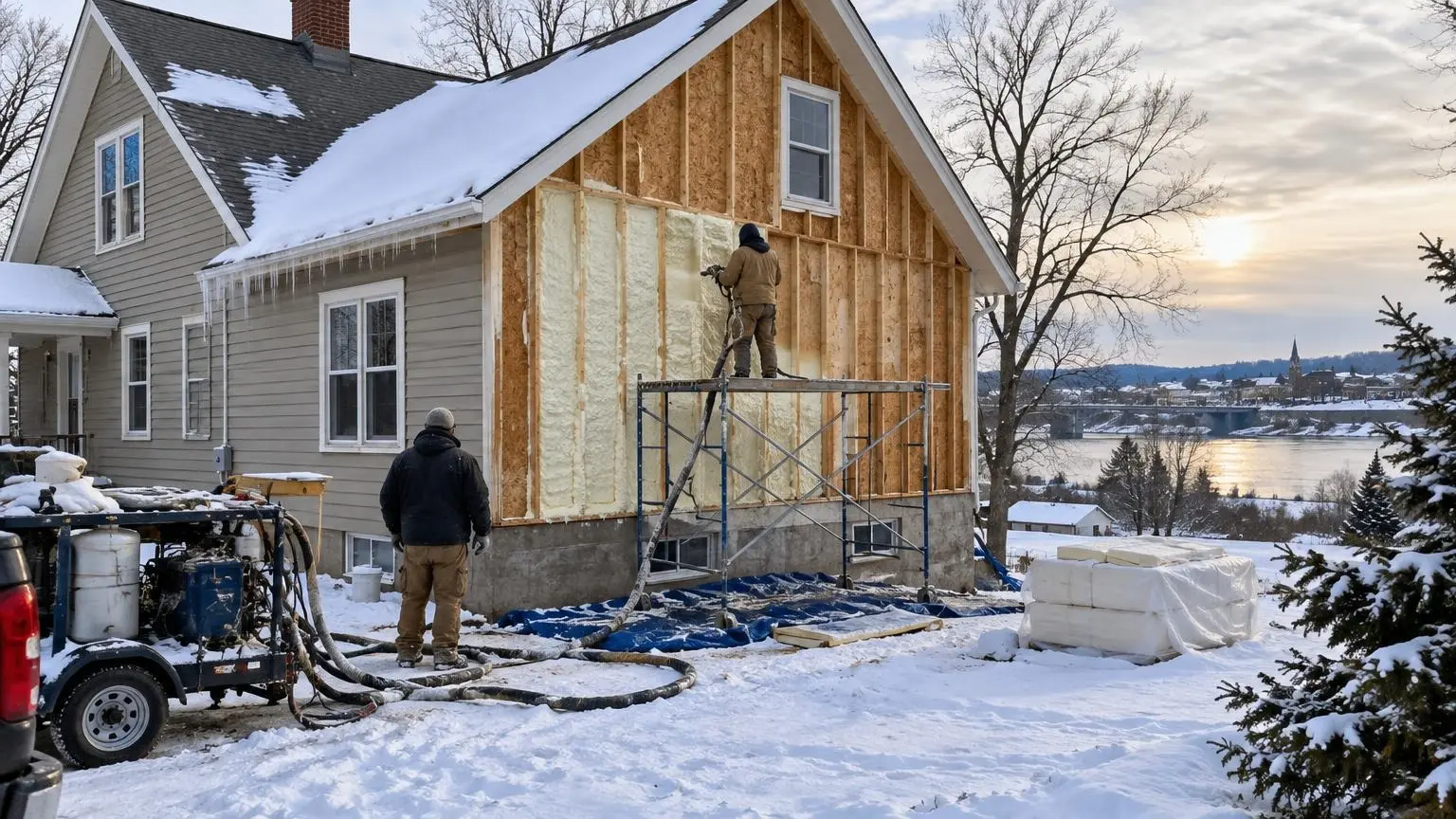
Melrose, western Stearns County on I-94
Spray Foam Insulation in Melrose, MN
A town with some of the coldest recorded temperatures in the St. Cloud area and a steady, settled population.
- Free on-site estimates
- Written quote showing the material, thickness and target R-value area by area
- Foundation walls checked for moisture before any foam goes on
How Cold Melrose Actually Gets
The town's own climate numbers make the case for spray foam insulation in Melrose. The 1991-2020 normals put the average January daily high at just 19.5 F, and the record low is -41 F, set in both January and December. Snowfall averages 39.0 inches annually. For a large part of the year, homes here sit with a wide gap between indoor and outdoor temperatures, and every air leak pushes heat across it.
Where the heat goes
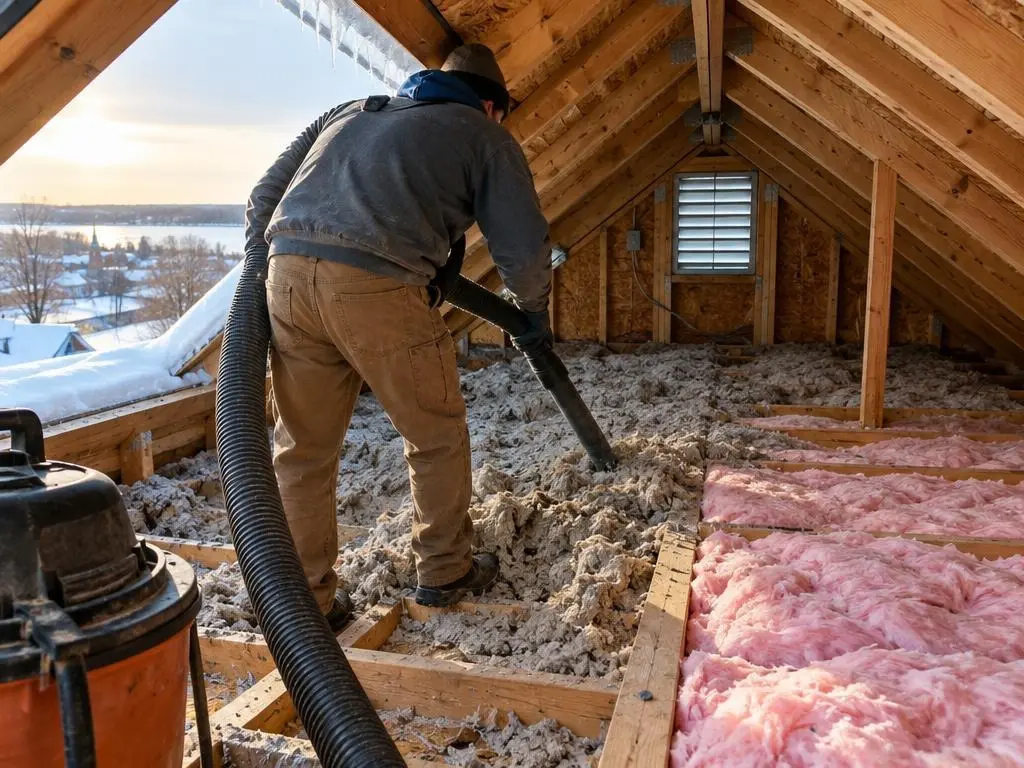
In a typical Melrose home, warm air rises and escapes through the attic floor at light fixtures, top plates and plumbing chases, while cold air is pulled in at the basement rim joist and around the foundation. That stack effect gets stronger the colder it gets outside. On a -20 F night, it is working at full strength. Sealing both ends of the house, the attic floor and the rim joist, is what slows it down.
Choosing materials
Closed-cell spray foam is our usual pick for the rim joist and for sealing hard-to-reach attic edges. It resists moisture and carries more R-value per inch than open-cell. For the main attic floor, blown-in insulation is often the most economical way to reach depth once the leaks are sealed. The DOE recommends R60 for an uninsulated attic in its coldest zones and R49 where there are already 3 to 4 inches.
A stable town
Melrose's population barely moved between 2010 and 2020, from 3,598 to 3,602. The 2020 census counted 1,403 housing units with a homeowner vacancy rate of 0.7%. Many owners here have been in their homes a long time, and long ownership is what makes insulation pay off.
Ice dams after heavy snow
Nearly 40 inches of snow a year on a roof with a warm attic underneath produces ice dams along the eaves. Air sealing the attic and keeping insulation full depth out to the eaves is the long-term fix, and it is far more effective than heat cables.
Get a free visit and a written quote. Get a free estimate or call (320) 433-6603.
Melrose Climate
- Record low. Melrose's record low is -41 F, recorded in both January and December, according to the 1991-2020 normals table.
- January highs. The average January daily maximum in Melrose is 19.5 F, against 80.9 F in July.
- Snowfall. Melrose averages 39.0 inches of snow and 29.08 inches of total precipitation a year.
- Stable housing. The 2020 census counted 1,403 housing units in Melrose with a homeowner vacancy rate of 0.7%; the population went from 3,598 in 2010 to 3,602 in 2020.
Melrose Questions
How does the cold make air leaks worse?
The bigger the temperature difference between inside and out, the harder warm air pushes out the top of the house and pulls cold air in at the bottom. On the coldest Melrose nights, that effect is at its strongest.
Are heat cables a good fix for ice dams?
They can help in a specific spot, but they treat the symptom. Sealing attic air leaks and adding insulation keeps the roof cold so ice dams do not form in the first place.
What R-value should a Melrose attic have?
The DOE recommends R60 for an uninsulated attic in its coldest zones, or adding R49 where 3 to 4 inches already exist.
Is closed-cell foam worth it on the rim joist?
In our experience, yes. It seals the gaps, resists moisture and adds more insulation per inch than other materials that fit in that small space.
Free Estimates in Melrose, MN
Melrose homes and nearby farms get a free, written estimate.
Spray Foam Insulation Near Melrose
- Spray Foam Insulation in St. Cloud, MN
- Spray Foam Insulation in Sartell, MN
- Spray Foam Insulation in Sauk Rapids, MN
- Spray Foam Insulation in Waite Park, MN
- Spray Foam Insulation in St. Joseph, MN
- Spray Foam Insulation in Cold Spring, MN
- Spray Foam Insulation in Rockville, MN
- Spray Foam Insulation in Clearwater, MN
- Spray Foam Insulation in Becker, MN
- Spray Foam Insulation in Big Lake, MN
- Spray Foam Insulation in Elk River, MN
- Spray Foam Insulation in Monticello, MN
- Spray Foam Insulation in Annandale, MN
- Spray Foam Insulation in Paynesville, MN
- Spray Foam Insulation in Albany, MN
- Spray Foam Insulation in Sauk Centre, MN
- Spray Foam Insulation in Avon, MN
- Spray Foam Insulation in Rice, MN
- Spray Foam Insulation in Foley, MN
- Spray Foam Insulation in Princeton, MN
- Spray Foam Insulation in Milaca, MN
- Spray Foam Insulation in Cambridge, MN
- Spray Foam Insulation in Alexandria, MN
- Spray Foam Insulation in Zimmerman, MN